
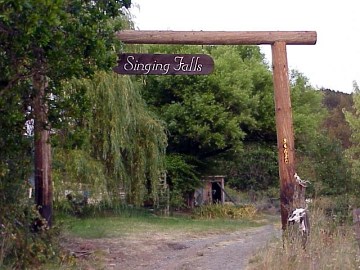
Entrance to Singing Falls Ranch
~~*Rural - Meaningful Living*~~
We have wanted so much to recover the valuable strands of the broken thread between the past and present. Not that we have a notion to revert to a primitive state as much as to take a hold on those elements of life, nature and spirit that have the unique quality of being timeless in their worth in regards to wisdom, health and well being. We have found ourselves being radically independent of so much of contemporary society and yet very desirous of that sense of community that other generations have valued. We are very aware of the fact that more often than not community living centered around some ethnic, religious and or political commonality. It's very powerful to have such a medium as the www to be able to observe and perhaps enjoy the subtle or perhaps drastic differences in individuals without the often deep sense of vulnerability associated with sharing "religion and politics". Our lifestyle is an amalgamation of old and new that we'd be glad to share with you. Let's start with our herb garden.
We so appreciate the plant kingdom. So often some ailment or other need has been met around here simply by going to the herb garden or the woods and gleaning some treasured essence from a plant. One of the shocking lessons of my young adult life was to learn that many, many of the contemporary medicines are mere synthetic copies of some lowly herb or bark or leaf. That was in the 60's.
Today, though our knowledge of just what's out there seems so very limited, there's hardly a day that goes by that we don't avail ourselves to some proven essence derived from grasses, forbs, trees and the like. We've amassed a small library to compensate for the knowledge that didn't get passed down to us from previous generations.
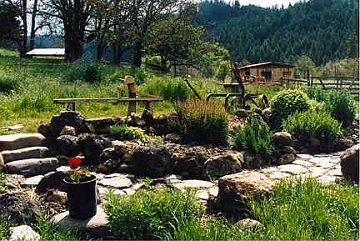
An Herb Garden of Singing Falls
Our herb garden has three main aspects: culinary, medicinal and dye plants. It's nowhere near what it should be in size but it's a good start and a job to manage as it is. We have several mints including chocolate mint and catnip. Yarrow, feverfew, wormwood, horehound, parsley, sage, rosemary and thyme along with quite a few others in the rock garden. Our region of the country boasts a tremendous diversity of wild sources of food and medicine. The herb garden picture also includes my "three gang" plow (it has three plow blades) and the home made "shave horse"
Our vegetable garden is a raised bed organic one. We've used this technique for three decades and have found it profoundly efficient and enjoyable to work. We do not use a rototiller but we do use a combination of spading, forking and vermiculture (worms!) to work our heavy clay soils into a rich humus. The barnyard manure, which we have in abundance, works wonders to feed and develop the micro-world of the soil. The by products of those invisible workers nurtures the plants from which we derive our sustenance.
Winter is full of rain. I noticed that the precipitation would literally pound the clays down and most organic elements from the previous year would be gone by spring so I developed this technique. In the fall the earth is spaded and forked. I work any amendments I think the soil needs in at that time. A heavy layer of mulch (4 -6 ins.) is then placed on the raised beds. In the past we have used oxen manure for the mulch which worked superbly. One of the side effects in the pasture of bovine manure is called "heavy loading". The nature of the material is such that it suppresses plant growth where it lays. We decided to take advantage of this characteristic to enrich the garden and control weeds. By spring the soils have not been compacted by the rain, and the worms have worked the organics into a ready made bed. Much of the nutrients are still in the region of the root systems of our veggies because the top layer of fertilizer also acts to prevent a total diluting of the plant food by diverting the rain considerably. Our garden has fed us substantially.
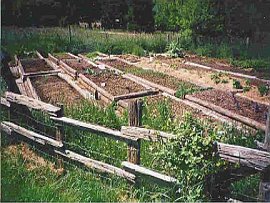
Raised Bed Organic Garden in the Spring
In the past we have watered it long into late autumn by an underground poly-pipe over 2,000 feet away that connects to our water inlet in Joe Hall Creek. It is a gravity fed water system and works very well for us. The drop in elevation from the water inlet to our garden providing enough of a flow to run two sprinklers. Just recently we have committed to temporarily abdicate this excellent feature of our homestead in order to provide the stream with extra water for salmon fry which have mysteriously spawned in our segment of the stream after having not been seen here for over fifty years. The expense and effort to put in a well is worth it. Our hope is to restore aquatic habitat in Joe Hall Creek so that the teaming life of the stream will flourish and ultimately provide us with a more reliable year round water source - gravity fed!
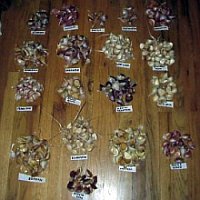
Garlic Varieties
We're currently using our 240 foot deep bore drilled well, that we have dubbed "Mozama Waters", for garden irrigation. Our hand dug 36 foot well is fully functional also. Actually, dug is the wrong term. I used a 90lb jack hammer to open the hole in solid rock!
One of our favorite crops - garlic. Each year we plant from 400 to 900 plants of different garlic types that have various culinary and medicinal virtues. During the 2002 growing season we have planted 28 varieties from around the world. Garlic is a most forgiving plant that grows well in various soil types. Planted in the fall it is ready for harvest by early July or late June. We put it in many dishes but we especially enjoy the whole bulb dry roasted. Many of our animals have benefited from it's use also. Alexandra has nursed very sick calves, lambs and kids back to health with an herbal concoction whose main ingredient is garlic. It purges parasites, has antibiotic qualities, assists in cholesterol control, repels harmful insects from the garden and people, if we eat too much.
It is astounding to see just how many varieties of garlic there are. In 2006 a local intentional community has 78 unique garlics growing here at Singing Falls. The proprietor organically grows his exotic cultivars out of shear fascination. Some are hot, others sweet(ish), some keep for long periods and quite a few need to be used before Winter sets in. Ethnic groups from around the world have establish and emphasized special traits of their brand of the plant with phenomenal success. We use as many as we can.
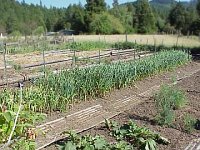
Garlic - Used for Medicine and Food
Below is a photo of apple blossoms on a tree set in our orchard. Apple blossom time at Singing Falls is always a busy time for the bees (see in the distance a white painted hive body.) One of the drawbacks of living on the "marginal lands" that often interface with the wilderness is the harsher climate. A surprise frost in mid spring often sets the fruit back. We have lost several trees to insect damage as a result of avoiding chemical treatments but the main culprit is the weather. Last year the young Gravenstein was lost to the severe drought. It's always "survival of the fittest" in both the animal kingdom as well as the plant kingdom, and the Gravenstein had already suffered some insect damage the previous year. It seems the drought took a heavy toll on the land. Water is crucial to life, and in spite of the deep roots laid by some of our young trees and the vineyard, we experienced loss from its lack. After the hot, bitter seasons of dry blasts from the west, even the four feet of winter rain can not wash away the foreboding beauty of a clear blue sky. Thus is the lot of those tempered by the elements. Our new deep well and pump system is working wonders now. That same sun, which mercilessly bakes the south facing clays of the large meadow, is pumping our water!
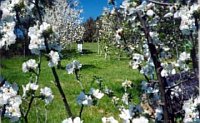
Bee Heaven
We don't use pesticide spray for insects simply because we don't know what's working in the readily available pesticides. What did people do before there were sprays? It's a tough battle. Our apples are mainly for storing and cider. We have a 1700's variety English cooking and cider apple called Brambly that we've recently planted that seems to be taking a good hold on the soil.
There are quite a few apple and pear trees spread over the property planted by this homestead's past residents. Louis Thomason, quite the fruit grower in the way of apples and pears back in the 20's and 30's, planted a wide array. The story is told that thieving youngsters in those days would steal the man's apples and pears, toting the fruit away while he slept. (We assume this may have been during the country's depression era.) He apparently had "had enough" of their thievery and cut down a multitude of his fruit trees, we're told.
There are still a few nice old trees with unusual varieties of fruit attendant upon their gnarly branches. There's an ancient tree in the field adjacent to a running rivulet of water that doesn't produce many apples - but its round yellow fruits are tasty, nonetheless, tantalizing us with the taste of cinnamon and banana when we bite into the juicy and crispy fruit. Old Ike Wilson across the way said that indeed it was called in its day "a banana apple".
Mrs. Wilson, on the other hand, always told us that the pear tree out by the spring in the far pasture was called a "Sugar Pear tree". She said the early pioneers used those sweet pears to do all their fruit canning with, the juice of the fruit being as sweet or sweeter than sugar water. It's amazing to trace the history of this land back to its pioneer roots, and one must allow for legend and lore, which sometimes overlaps a bit with the truth.
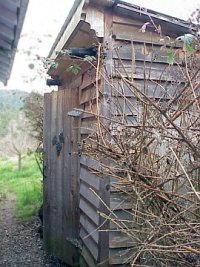
Entrance to the Root Cellar
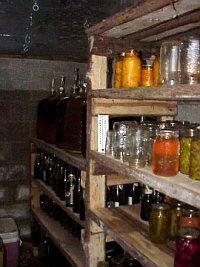
The Bounty in the Root Cellar
Our root cellar holds the bounty of the year's garden and harvest labors. It's simple structure is made of cement blocks set into a hill behind the cottage. Usually the temperature ranges from 40 to 60 degrees F, though 50 degrees is nearly constant. Since the Oregon winter is so wet the humidity stays very high during that time of year. It makes an excellent storage area for root crops, apples and canned goods. The large bottles in the back are carboys used to hold the year's various types of wines. The ceiling and front end are super insulated and lined with foil (like a thermos.)
We have installed a Solahart hot water heater and it's been an incredible asset. This winter we have been amazed to feel the warm water flowing into our propane heater. Even on the mostly overcast winter days of Oregon we are able to generate a substantial amount of heat to prewarm the water. Some of these late February and early March days when the morning temperatures were in the 20's but the skies were crystal clear, we knew the sun would burn off the frost on those panels and we'd have hot water soon enough. Sure enough, the water was not only "prewarmed" but actually HOT. On these days the back up pilot light (propane) never turned on. The Slat system supplied our hot water needs in total. It was days like this that Alexandra gladly washed the mohair fleeces, knowing the sun was heating the water and not propane.
In the summer (when we wash most of our mohair fleeces) water blows out of the release valve which is set at 180 degrees Fahrenheit. It's a great system and works well in spite of its age (ten years old.) Its 80 gallon tank holds a lot of weight in water (near 1,000 lbs total system weight), so I was careful to build a secure platform out of treated lumber, attaching it carefully to the cottage shed over which it stands
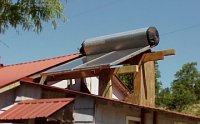
Solarhart Water Heater
Solar energy is incredible. We used it for years on our Montana homestead. The ten years we spent there was a season in which we learned to function quite efficiently (and self-sufficiently, I might add) off the main power grid. For the first half dozen years our sole source of electrical use was a 12 volt deep cycle battery that was charged in the pickup truck when we ventured into town.
When we managed to fall into a good deal on some photovoltaic solar panels we just couldn't pass up the offer. The array is currently configured into a 120v DC supply for our grundfos submersible pump. A friend from Montana supplied us with a never used older model Trace Inverter but we'll use twelve volt lighting in the barn just as we did in Montana. With the onset of high energy prices once again there should be an upsurge of interest in energy supply alternatives. I'm glad to see the heavy burden of petrol use having at least one upside.
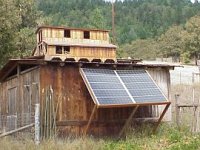
Solar energy panels
The SQFLEX 6 grundfos pump was a big investment but well worth it. It is a helical driven variable power supply pump that will run on 90 to 240 volts AC or 30 to 300 volts DC. Water ever you throw at it will run it. So far we are very pleased with the steady supply of pure "Mozama Water" that it has extracted from deep in the earth by the sun.
We heat only with wood. Below is a photo of our "five run flue" Russian masonry furnace. We had a "grubka," (Russian masonry furnace) in Montana also). The principles upon which masonry furnaces operate are very simple. The real beauty of this simplicity is in the furnaces extreme efficiency. I spent quite a bit of time several winters back producing an informative multimedia presentation on CD. Plans, method of use and other valuable information is available for a nominal fee on our masonry furnace web page.
We joke with Alexandra's father (who heats his large "den" with a conventional woodstove - stoking it continually all the day long with large pieces of oak) telling him: "Well, it was a cold one today, dad. All of 38 in the sun, and countin' downward. Had to heat the place with seven toothpicks instead of five" :).
Stan insists that you don't have to be a mason to build one. With a little study of masonry skills and a thorough understanding of the principles upon which the heating system is built, a careful industrious person can economically build one by himself. We heated our home in Montana with one -- an 1800 square foot log home. Our "back up" heater was a French Godin parlor stove set up in our large living room area, but most of the heat for the home came from that masonry furnace.
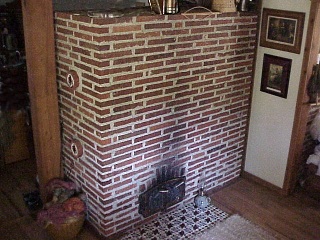
The Russian Masonry Furnace-click
I used Washington State code plans for building our Oregon and Montana furnaces. Our house (cottage) is so much smaller than the one in Montana (all of 900 square feet if you stretch your imagination to its limits) - and therefore, its wood needs are minimal. Usually (winters, I speak of) we fire up the furnace once per day -- in the night hours -- with a "charge" of dry wood. Small pieces are always best for the burning, for they ignite readily and burn steadily and hot for a short time. The charge burns until there is a lick of blue flame spiraling upwards in the firebox. (gold flames are flames that indicate volatile gases are still being released) The tender of the fire must be aware of all of this and watch his grubka carefully. When the blue flame is seen on hot red coals (around 45 minutes after first firing)- the tender "shuts 'er down." The damper is closed off then and all the flue apertures are closed for a near airtight seal. The furnace will then radiate its glowing heat throughout the next twenty four hours.
It's like having a huge warm rock in the middle of your house. After spending the cold Montana nights stoking a conventional convection wood burning stove sometimes every two hours, the masonry furnace was all the more appreciated. Even here in mild Oregon the furnace's 24 hour cycle saves a lot of time and energy in wood gathering, splitting and burning. The charge used is very small compared to the average amount of wood consumed with typical wood stoves on a daily basis
Whatever you choose to name it, the masonry stove is one of best choices you can make. Ours does not utilize some of the features of the typical Russian grubka that has been known to exist for centuries in the cold areas surrounding Siberia. Some had a wooden "shelf" that wraps around the unit - serving as a warm bed for a weary and cold body nesting against the stones or brick or limed over grubka. Others had warming ovens to raise bread or warm up boots. Still another neat feature was a built in wood cook stove. Our cottage is too small for that, but we appreciate the unit we have built immensely.
Anyone with rudimentary homesteading skills, patience and armed with the fundamental understanding masonry techniques should be able to build one.
Oregon is a majestic land and its seasons, though not as varied as the seasons were when we lived in Montana, never fail to amaze us with their beauty. The pictures below show the same pasture at two different seasons. On the left you can view one of our misty afternoons as rain clouds dissipate (a pretty regular scene here.) On the right you see late summer at its apex, nary a cloud in sight - Oregon drylands, Oregon badlands, where the Indians dwelt and the wagons then came along, and where the prairie was still new and fresh and bountiful enough for any who lived there.
This is one of our meadows. It is the largest of three places we utilize for pasture and it isnaturally opened in the midst of our heavily forested region.
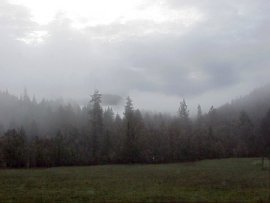
Winter Field
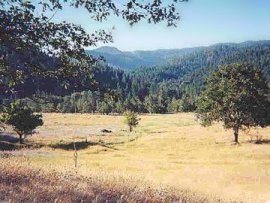
Summer Field
Generally the trees that inhabit the field are white oaks with a smattering of black oak, madrone, Douglas fir, yellow pine, and a host of shrubs of various kinds and rarer confers. Fruit trees of various sorts have taken root in and around the fields also. A wide variety of grasses and forbes flourish in this sub-irrigated area. If we could market this large field of pennyroyal that comes up each year, we might do well for ourselves! I've often wondered if the natural menthol found in the pennyroyal flowers that our bees work like crazy during early summer is what has been so responsible for keeping the mite problem at a minimum in our hives. It's a thought worth consideration, anyway.
This are our livestock guardian dog. Up until recently only Australian Shepherds could be found with us. Predation problems due to mountain lions, coyotes and nears became so severe that we had to develop a multifaceted proactive approach that included finding a guard dog to protect our precious herd.
Uzi our first Livestock Guardian Dog (LGD)
We can hardly begin to convey the intense hardship that is associated with interfacing with the wilds in regards to livestock management. For years we experienced great heartache at the loss of many precious members of our band of goats and the small flock of sheep. After a protracted battle that almost finally consumed us financially and emotionally and answer to our dilemma came. Today, we have two LGDs that have completely relieved us of the formidable task of predator control. There hasn't been a lion incident in eight years here but my neighbors continue to suffer loss. Full of stealth and anatomically geared for success in the hunt, the North American Mountain Lion is rarely seen. But in recent years the feline populations of the North Eastern and South Western sections of Oregon have exploded.
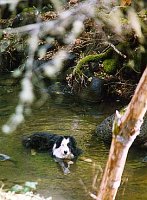
Caleb in Joe Hall Crk. thinks he's cool!
This is Caleb, our much too intelligent Australian Shepherd male, telling us he's cool! We've raised "Aussies" since 1977 and I can't say enough good about them as an asset to the homestead. They can get protective but that's a minus that can also be a plus in this lifestyle. "A good dog will take the place of three men on horses", the saying goes in these parts of the country. In the seasons of his strength Caleb responded to voice and hand signals and had a extensive vocabulary. Nowadays (he's fifteen years old as of 2006) he lounges about enjoying the easy life. In those days his help was indispensable. You have no idea what a help an Aussie can be until you've chased the herds up and down the mountains sides half the afternoon. The stock know your limits and will take full advantage. The agility and herding instincts of the shepherd dog illicit only one thing from the bands - respect!
Since Australian Shepherds are so popular in various arenas of our society we make the effort to have a litter of pups once a year. It's great to see this essential aspect of our homestead appreciated for it's other unique characteristics in our culture. Intelligence and filial bonding, agility and loyalty make them the ideal all around dog. Did I say I was proud of Aussies? If you come to this site via an interest in Australian Shepherds please visit our web page centered on this special breed of dog.
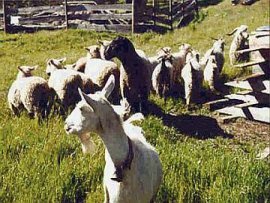
A herd of goats is called a band
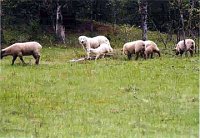
A herd of sheep is called a flock
Sheep and Goats - fiber, meat and milk! Having been a strict vegetarian in the past I have come to the conclusion over time that I am genetically predisposed to meat eating. I wouldn't say we are omnivores but fish, poultry and red meat are on our menu. Herein lies another intense aspect of our lifestyle. The vast majority of our meat supply is provided by our herd and flock. Inherent in this juxtaposition of symbiosis is the extreme difficulty in harvesting meat. It is the most emotionally strenuous task for us. Most people western culture simply go to the local store and pick up a nice plastic wrapped package of red stuff. That very act creates a disjoint with real life. Not only does the accumulated hard work and effort that brought the food into your hand escape you but the stark reality of the sacrifice some living creature made to sustain you never reaches your psyche. Since the entire process of food preparation in is our hands we benefit manifold from it. The individual members of our flock and herd receive the utmost care and comfort during their lives. We guard them against the unnatural intrusion of hybrid chemicals and keep their food consumption as natural as possible within our means. But that's another ball od wax as it were. Even with our best efforts we know that most of the grain feeds supplied for livestock are genetically modified and we are not set up for grain harvest production. We're just too old and there is much too much to do. Not complaining you understand. Just aware.
One big advantage of a home grown meat supply is a reasonable amount of assurance that ill fated "quick grow and disinfected" stock feeding and meat processing practices are avoided. I am very concerned that genetically modified meat is about to be a common offer at local supermarkets. If you are also a conscientious eater don't begrudge the organic market its just do in cost to you. Your paying many people not to cut corners with your food supply preparation.
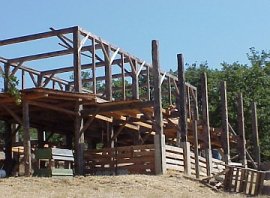
The forever project 2002. 2 stories.
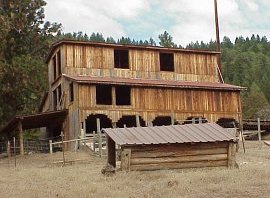
The forever project 2007. 3 stories.
One on going project on this homestead has been the timber frame barn that I've been hard at work building for many a moon. The timbers were cut using a Stihl chainsaw and an Alaskan Mill. Some of the main timbers were yew wood, a particularly hard wood that is naturally rot resistant. The wood is so hard, in fact, that if one pounds a nail into it - that nail is secured there forever - no getting it out without damaging the timber!
The barn's progress has been slow, but at this time (early spring 2002) we are just about ready to put the roof rafters up - though there is a strong possibility another floor will go up before the roof is finally put on. Our faithful friend, Todd, has been an enormous help along the way, also, his help being of immense value to us during some of the initial phases of the project.
Essentially, this barn is built like all timber frame barns were during America's long history with barn building. Most of these structures are widely scattered throughout the east and midwest. It is a time honored way of building, the structures usually outliving their builders by 100 years or more. It's the way our forefathers built their barns, in a time when balloon frame building with presized lumber was non-existent. It's slow and tedious, but as Stan often says, "If you have more time than you do money, it's the only way to build."
The timbered barn will house (on its second story) a weaving studio for Alexandra. She is excited to "move in" and has watched the project as it has gone forward, often making requests in regard to her studio that were not original to the plan for the room. Now it seems she will get her "windows that face south to view that incredible mountain vista" and a step down alcove that will house her favorite loom.
More information is available on the barn project by going here - Timber Frame.